Here is a comprehensive, original English blog post based on the key ideas presented in the transcript. It has been rewritten to meet professional SEO standards, improve readability, and provide a structured analysis of China’s advancing technology landscape.
The Future is Now: Decoding China’s Unprecedented Technological Revolution
For decades, global narratives often painted China as a follower, a nation of mass production and imitation. Today, that narrative has been shattered. The modern reality of China is not one of catching up, but of leading. From the depths of the ocean floor to the infinite potential of fusion energy, the country is executing engineering marvels that are forcing the Western world, particularly the United States, to reevaluate its position in the global tech hierarchy.
Industry experts and scientists are increasingly vocal about the shift. They suggest that the scale and speed of these developments are not just incremental improvements but a fundamental leap in capability. This article dives deep into the specific mega-projects and technological breakthroughs that are defining this new era a period where China is transforming from the “world’s factory” to the “factory of the future.”
The Bohai Undersea Tunnel: An Engineering Marvel
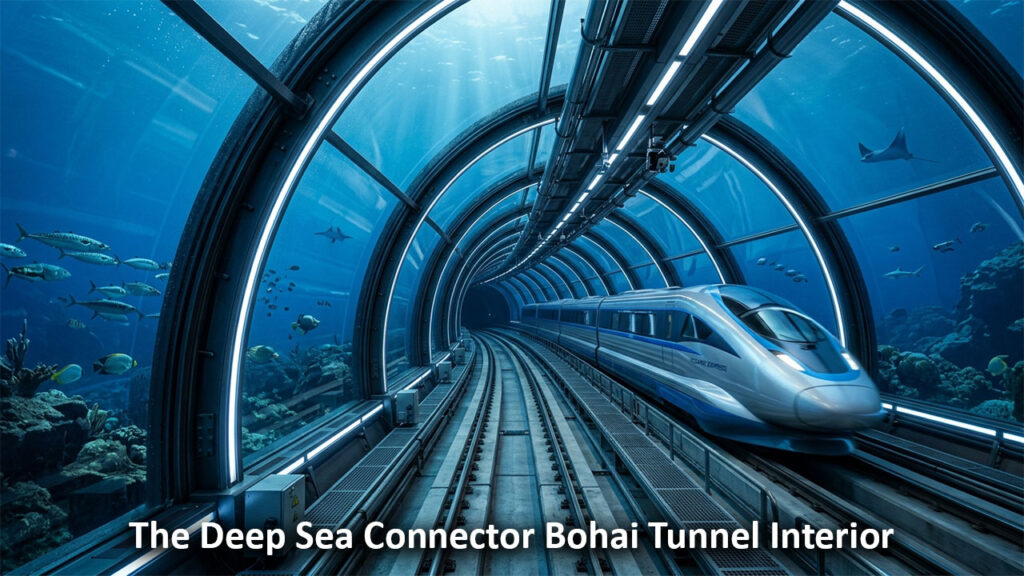
In the realm of civil infrastructure, no project captures China’s ambition quite like the Bohai Undersea Tunnel. While Europe relies on the famous Channel Tunnel connecting London and Paris, China is undertaking a project that dwarfs it in scale and complexity.
Connectivity Beyond Limits
The goal is to connect the major northern port cities of Dalian and Yantai. Currently, the journey between these two economic hubs requires a long detour around the Bohai Strait, taking approximately 8 to 9 hours by road.
The new tunnel aims to eliminate this bottleneck. With a projected length of 123 kilometers, it is set to become the longest undersea road and rail system on the planet, nearly twice the length of the Channel Tunnel. Once operational, the travel time is expected to plummet from several hours to just 40 minutes.
Technical Specifications and Resilience
This is not just a simple road. The design is a tri-level infrastructure masterpiece:
- Roadway: For standard vehicular traffic.
- Railway: Dedicated lines for high-speed bullet trains to pass beneath the ocean.
- Emergency Systems: A critical third layer for safety and maintenance.
One of the most impressive aspects of this project is its focus on resilience. The engineers have integrated AI-controlled monitoring systems and specialized water-pressure balancing chambers. Crucially, the tunnel uses floating segment designs that are earthquake-resistant. It is engineered to withstand a magnitude 8.0 earthquake on the Richter scale, ensuring that the structure remains safe and operational even under extreme seismic stress.
The economic implications are massive. By linking the industrial zones of Northern China directly, this tunnel is expected to facilitate trillions of Yuan in annual trade, acting as a vital artery for economic growth.
The 600 km/h Maglev: Redefining Speed
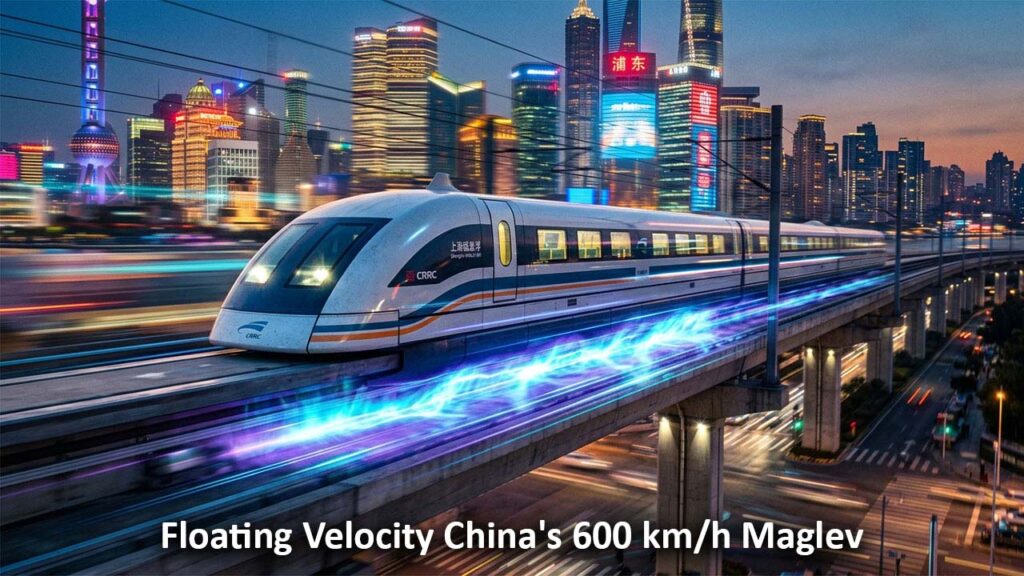
The future of ground transportation is not rolling; it is floating. China has successfully developed and tested a High-Temperature Superconducting Maglev train that is rewriting the rules of physics and travel.
Floating on Air
Utilizing magnetic levitation (maglev) technology, this train does not touch the tracks. Instead, it hovers a few inches above the ground, guided by powerful magnetic fields. This eliminates physical friction, allowing for speeds that were previously thought impossible for land-based vehicles.
This specific prototype, developed in the city of Qingdao by the state-owned CRRC corporation, has reached speeds of 600 kilometers per hour. To put that into perspective:
- It is faster than many commercial aircraft during takeoff.
- A journey that would take several hours by car is reduced to minutes.
- For example, a trip from New York to Washington, D.C. could theoretically take under 30 minutes.
Indigenous Innovation
Perhaps more significant than the speed itself is the origin of the technology. This train was developed entirely by Chinese engineers and scientists. After years of relying on technology transfers from Japan and Germany, this breakthrough signifies that China has achieved total technological self-reliance in high-speed rail. It is a clear signal that the leadership in transportation technology has decisively shifted toward Asia.
The Artificial Sun: Tapping into Star Power
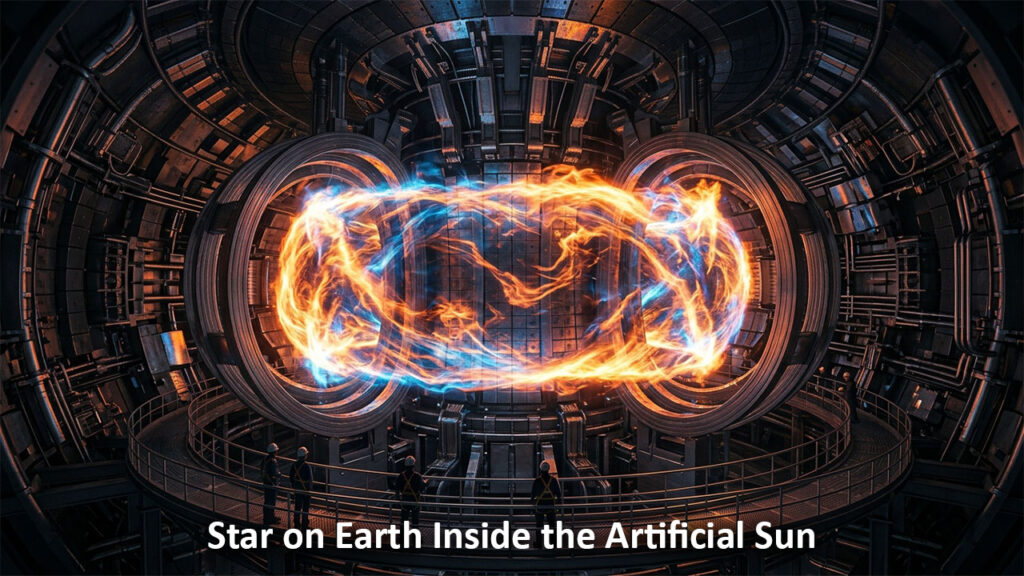
While the world scrambles for oil, gas, and coal, China is attempting to build a star on Earth. In the city of Hefei, scientists are working on the Experimental Advanced Superconducting Tokamak (EAST), often referred to as the “Artificial Sun.”
The Science of Fusion
The goal of this reactor is to replicate the process that powers our actual sun: nuclear fusion. Unlike nuclear fission (used in traditional nuclear power plants), which splits atoms and produces dangerous radioactive waste, fusion merges atoms. The result is an almost limitless source of clean energy.
The technical challenges are immense. To achieve fusion, the reactor must generate incredibly extreme temperatures. The plasma inside the reactor has reached temperatures of 150 million degrees Celsius, which is approximately five times hotter than the core of the sun.
A Future Without Fuel
The promise of this technology is staggering:
- Unlimited Fuel: It uses hydrogen isotopes found in seawater, making fuel supply virtually infinite.
- Zero Pollution: The byproduct is helium, an inert, non-toxic gas. There is no greenhouse gas emission.
- Safety: Unlike fission, fusion reactions are inherently safe and cannot “meltdown.”
While significant scientific hurdles remain, China has announced ambitions to utilize this system for a large portion of its energy needs by 2050. If successful, it would represent the greatest achievement in energy production in human history, potentially eliminating the world’s dependence on fossil fuels forever.
The Automation Age: The Rise of the Robotic Workforce
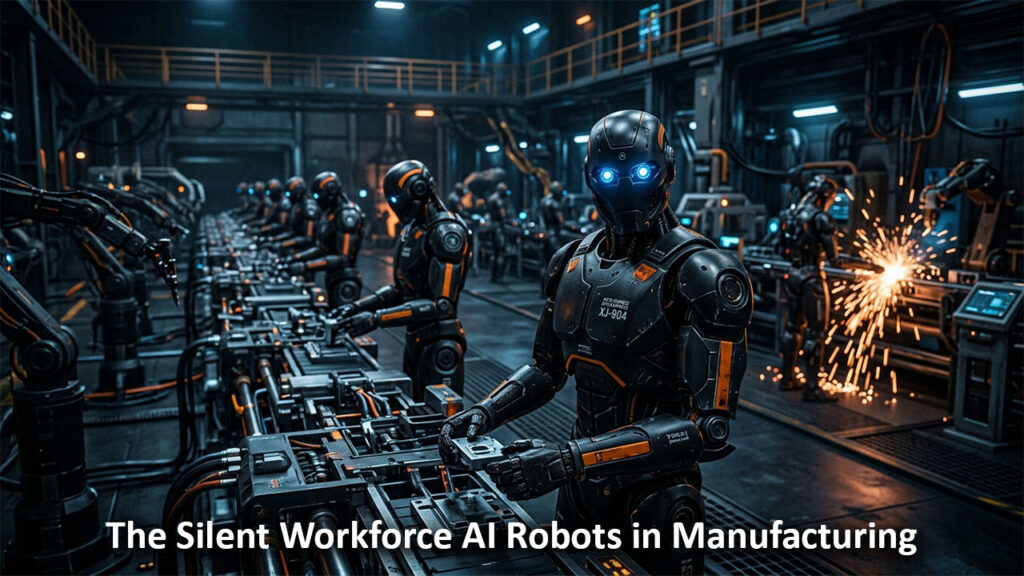
Walk into a modern Chinese factory, and you may notice a distinct lack of humans. The nation is undergoing an aggressive transition toward Industry 4.0, replacing human labor with intelligent robotics at an unprecedented rate.
A 24/7 Production Cycle
These are not the simple robotic arms of the past. The new generation of industrial robots is powered by advanced Artificial Intelligence (AI).
- Autonomous Decision Making: They can analyze production data and make adjustments to improve efficiency in real-time.
- Machine-to-Machine Communication: These robots communicate with each other, coordinating tasks and reporting errors without human intervention.
- Zero Fatigue: They work 24 hours a day, 7 days a week, without the need for breaks, sleep, or shift changes.
This shift is transforming China’s manufacturing sector. While this raises questions about employment and the future of manual labor, it ensures that China remains the most efficient and cost-effective manufacturing hub in the world, driven by software rather than just manpower.
Vertical Cities: The Solution to Urban Sprawl

As China’s population grows, the government is looking to the skies for solutions. The concept of the Vertical City is moving from science fiction blueprints into actionable urban planning.
Living in the Third Dimension
The principle is to condense an entire urban environment into a single, massive superstructure. Instead of spreading horizontally across miles of land, the city is built upward.
In this model, a single mega-tower would house:
- Residential apartments
- Corporate offices
- Public parks and green spaces
- Shopping malls and entertainment districts
Everything a citizen needs would be accessible within a single structure. This approach aims to drastically reduce commute times, eliminate urban sprawl, and preserve the natural environment by reducing the physical footprint of human habitation. Combined with the development of flying cars, which are currently entering practical testing phases in China, the sky is literally the limit for urban development.
Key Takeaways
- Infrastructure Dominance: China is building the world’s most resilient and longest undersea tunnels, cutting travel times by over 80%.
- Transportation Supremacy: The 600 km/h Maglev proves that China has mastered the future of high-speed land travel.
- Energy Independence: The Artificial Sun project could make fossil fuels obsolete by providing unlimited, clean fusion energy.
- Efficiency: AI-driven robotics are creating a tireless workforce that maximizes production and efficiency.
- Future Living: The shift toward vertical cities indicates a complete rethinking of how human societies will function in the next century.
Conclusion
The narrative that China is merely “catching up” is outdated. The evidence on the ground, under the sea, and in the air suggests a nation that has entered a phase of exponential innovation. By mastering nuclear fusion, magnetic levitation, and extreme engineering, China is not just solving its own domestic challenges; it is setting the template for the global future.
While the claim that the West is “100 years behind” may be sensationalist, the sentiment behind it is grounded in a growing reality: the center of gravity for technological innovation has shifted. For the rest of the world, the race is no longer about leading China, but about keeping pace with it.
Frequently Asked Questions (FAQ)
1. Is the Bohai Undersea Tunnel currently open?
No. The tunnel is currently under development and construction. It is one of the most complex engineering projects currently active in the world, with a target to significantly reduce travel time between Dalian and Yantai upon completion.
2. How does the Maglev train hover without touching the ground?
It uses magnetic levitation. The train and the tracks are equipped with powerful electromagnets. These magnets repel each other, creating a magnetic field strong enough to lift the train off the ground and propel it forward at high speeds without friction.
3. Is the “Artificial Sun” safe?
Yes, the technology being tested is fundamentally different from traditional nuclear power. Fusion does not rely on a chain reaction, meaning a runaway meltdown is physically impossible. If the system fails, the plasma simply cools down, and the reaction stops instantly.
4. Will robots replace all human jobs in Chinese factories?
While the trend is moving toward full automation in specific sectors, the reality is a hybrid model for now. Humans are being shifted from manual labor roles to supervisory, programming, and maintenance positions where critical thinking is required.
5. What is a “Vertical City”?
A Vertical City is an urban planning concept where all the functions of a traditional city housing, work, leisure, and shopping are integrated into one massive, tall building. This saves land space and reduces the need for cars to commute between zones.
6. Does China currently have flying cars?
Yes. Several Chinese companies have received airworthiness certifications and are conducting real-world test flights for electric vertical take-off and landing (eVTOL) vehicles, often referred to as flying cars. They are expected to be commercially available for urban transport in the next few years.
7. Why is China investing so heavily in these mega-projects?
The primary drivers are energy security, economic growth, and urbanization. By innovating in these areas, China aims to reduce dependence on foreign technology and resources while solving the logistical challenges of a massive population.