
How Islam Came to India | Full Historical Documentary | STONE AGE TO ALMI DEENI MARKAZ
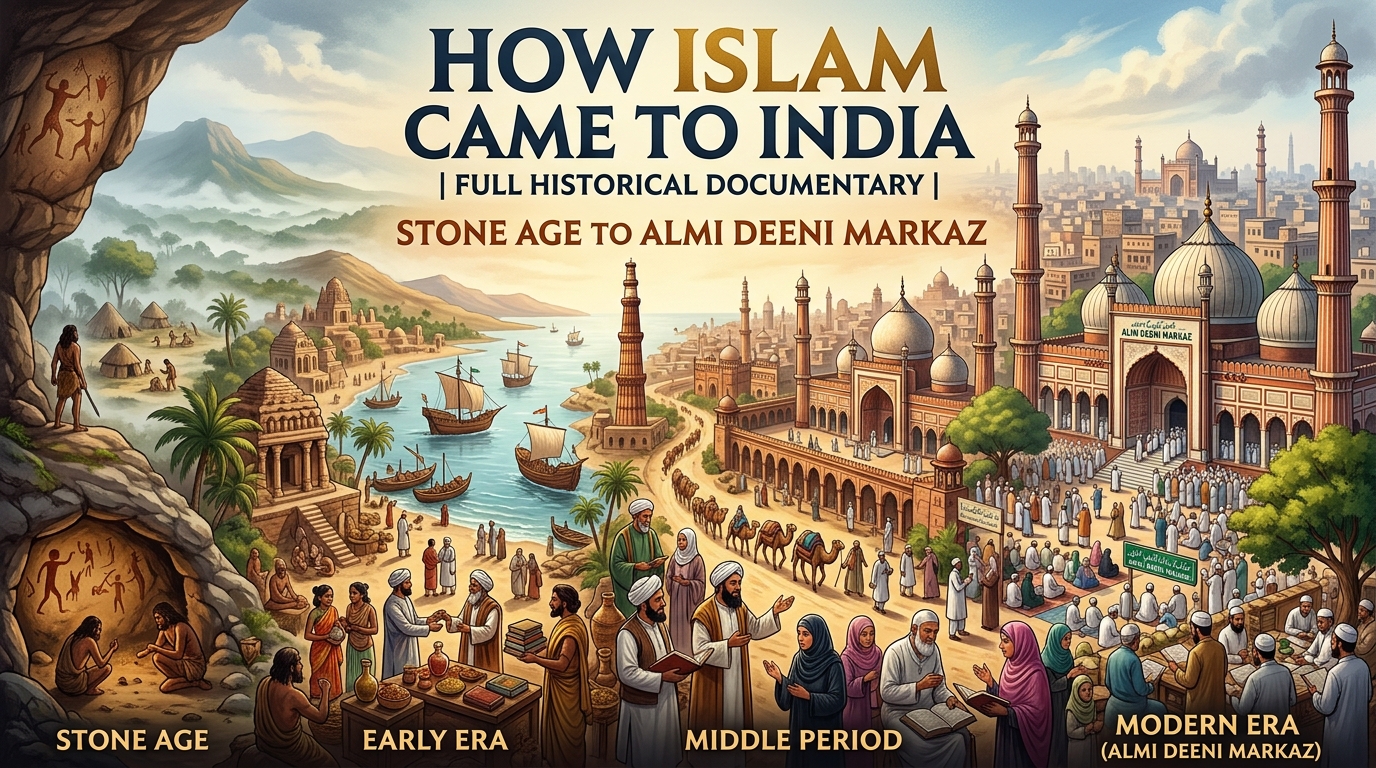
Hi, my dear viewers. Today, we will embark on a historical journey that begins with the ancient civilizations of India and reaches the advent of Islam. It is not just the advent of a religion, but a new thought, a new civilization, and a message of human equality that went down to the roots of this region. We will see how Arab traders came here, how the first mosque was established, how a young general conquered Sindh, and how Sufi saints changed hearts. This document will tell you how good character and justice, along with power, influenced millions of people. Get ready, because this story is just beginning.
This land of India has always been a center of change. Thousands of years ago, when there were no big cities, no empires, there were forests, rivers flowed, and people lived with stone tools. This was the Stone Age. Then time passed, and around 3300 BC, great civilizations like Harappa and Mohenjo-daro emerged. Straight roads, markets, water systems, and big cities. These people were traders and were far ahead of their time.
After that, around 1500 BC, the Aryans came here. They brought new languages, the Vedas, and the caste system. Brahmins, Kshatriyas, Vaishyas, and Shudras. Gradually, this system became the basis of Indian society. But spiritual thought also flourished on this land. The sages worshipped in the forests, and the Ganges was considered sacred and worshipped in large temples. Then came the Buddha and Mahavira. They taught peace, simplicity, and non-violence. Later, Chandragupta Maurya established a large empire, and Ashoka turned to Buddhism after the bloody war of Kalinga. He built roads, pillars, and Buddhist monasteries.
Time went on. The Rajputs became powerful. Their forts, swords, and martial traditions became famous. In the south, the Chola Empire ruled the sea trade. Indian spices, silk, and cloth began to reach the whole world. India was no longer just a land. It had become the center of civilizations, religions, and cultures. Somewhere, the temple bells would ring, somewhere the Buddhist monasteries would be silent.
And in the meantime, Arab traders began to reach the shores of India. They would be amazed to see the wealth, spices, and markets here. But they did not know yet that soon Islam would set foot on this land and the history of India would change forever.
In the seventh century AD, the deserts of Arabia were not silent. A voice that arose from Mecca and Medina was spreading rapidly throughout the world. Islam was not just a religion. It was a new thought. A new civilization that considered humans equal. Where slaves and kings could stand in the same row, in a few decades, Islam had spread from Arabia to Persia, Syria, Egypt, and Central Asia.
Now the eyes of Arab traders once again turned towards this ancient land. India, the land that the world calls the golden bird. At that time, India was considered one of the largest trading centers in the world. The coasts of Malabar, the ports of Gujarat, and the routes of the Indus were full of traders from all over the world. Pepper, cinnamon, cloves, silk, perfume, diamonds, and precious fabrics were sold in the markets of India.
Arab traders would travel for months at sea. They would find their way by the stars at night. Fighting storms and dangerous waves, they would finally reach the shores of India. When their large sailing ships anchored on the Malabar coast, the locals would look at them with amazement. Arabic clothes, turbans, camel-laden goods, and different languages. All this was new to the Indians.
But one thing made them different from everyone else. Their character. They did not lie in trade. They did not cheat in measurements. They kept their promises and treated the poor with respect. The people of India were seeing such traders for the first time. Gradually, relations between Arab traders and the locals began to grow. Friendships were formed in the markets, business grew, and some Arab traders settled in India itself. They married into local families, and small Muslim settlements began to form in the coastal areas.
At night, lamps lit up in small mosques on the seashore, and for the first time, the call to prayer echoed in the air of India. It is said that the first mosque of India, the Cheraman Juma Masjid, was built on the coast of Kerala during this early period. This was the moment when Islam was first establishing a permanent foothold on Indian soil.
But Islam was not spreading only through worship but also through morality. At that time, the caste system in India was very strict. The upper castes lived separately, and the lower castes were looked down upon. Some people were not even allowed to enter temples. But among the Muslim traders, people saw something strange. The rich and the poor stood together in prayer. Black and white were in a row. There was no caste, no high and low. And this began to sink into the hearts of many people. Some people began to accept Islam. Some were simply impressed by the morality of the Muslims, and some looked at this new religion with amazement.
This was only the beginning. Because Islam was still limited to the coasts. There were still large Hindu and Buddhist kingdoms in the interior of India. Kings and Maharajas ruled. Temples were filled with gold, and mighty forts stood on the plains and mountains.
At the same time, a new power was emerging in the Arab world. The Umayyad Caliphate and its powerful governor, Hajjaj bin Yusuf, set their sights on Sindh. It is said that a ship carrying Arab traders was attacked. Women and children were taken prisoner, and cries for help reached Iraq. Hajjaj became angry. He demanded that the prisoners be released from the ruler of Sindh, Raja Dahir. But the situation began to move towards war.
And then history heard the name of a young general. Only seventeen years old but with determination in his eyes, a sword in his hand, and the passion of Islam in his heart. Muhammad bin Qasim, the young man who was soon to set foot on the land of Sindh. And with whom a new chapter in the history of India was about to begin.
Muhammad bin Qasim set out with a great army. Horses, camels, catapults, and thousands of soldiers. After a long journey through the desert, he reached the land of Sindh. This was not just a war. This was the encounter of two civilizations. On one side was the Arab world, and on the other side was ancient India.
Muhammad bin Qasim first headed for the port of Deobanl. It was an important trading city of Sindh. High temples, strong walls, and a busy city on the seashore. The war began. Stones started raining from catapults. Arrows started flying in the air, and after several days of fighting, Deobanl was conquered. Then Muhammad bin Qasim moved forward. Nayran, Sivastan, and other areas gradually came under their control.
But the real battle was yet to come. Raja Dahir entered the field with his great army. Soldiers mounted on elephants, flashing swords and war slogans. The entire battlefield echoed with the sounds of battle. Muhammad bin Qasim’s army was small in number but strong in discipline, speed, and strategy.
Then the decisive battle began. Sand was flying. Horses were running. Arrows were raining, and in the middle of the field, Raja Dahir was fighting, standing on his elephant. Finally, the tide of the war turned. Raja Dahir was killed, and Sindh came under the control of the Arabs.
This was a historic moment. Because for the first time, the Islamic government had established a foothold on the soil of India. But Muhammad bin Qasim was not only a warrior. He also knew how to manage. He gave peace to many locals. Instead of destroying temples, he allowed people to continue their religion in many places. He restored trade and established new systems.
During this time, many people began to be impressed by the morals, equality, and justice of Muslims. Some accepted Islam, and some started living with the Muslims. But the success of Muhammad bin Qasim could not last long. Arab politics began to change. Hajjaj bin Yusuf died, and new rulers came to the Caliphate. Then, suddenly, the order was given to recall Muhammad bin Qasim. The young conqueror who had conquered Sindh at the age of only seventeen quietly returned. But with him came Islam, which was no longer going back.
After the conquest of Sindh, a new reality had emerged on the map of India. But it was not just a military victory. It was the beginning of a new era where justice and morality, along with power, also began to change the hearts of the people.
After this, Islamic influences gradually started moving towards interior India. But this spread was more through hearts than through the sword. With time, Arab traders who were previously limited to the coasts started reaching the interior cities. Trade started increasing through Gujarat, Sindh, Multan, and Delhi. The markets became more lively than before. People were seeing that Muslim traders did not lie, were fair in weight and measure, and were gentle with the poor.
At the same time, another great power emerged. Sufi saints stayed away from the world and worshipped Allah and served humanity. They did not go to palaces but went to villages and forests. They were neither kings nor generals. But there was truth in their language and peace in their character. They did not force people to become Muslims but influenced them with their morals. They fed the hungry, sat with the poor, and considered every person equal. That is why the hearts of the common people of India gradually started to incline towards Islam.
Because at that time, the caste system was very strict. Some people were called high caste, and some were considered low. But Islam said that all human beings are equal. This touched the hearts of the common people.
Time passed, and then great Muslim empires started to be established in India. Ghaznavid, Ghurid, and then the Delhi Sultanate. Qutbuddin Aibak, Iltimush, Alauddin Khilji. These kings were not only warriors, but they also established new cities, built mosques, and established a new administrative system. Delhi became a powerful center, and Indian politics began to change.
After this came the Mughal era. Babur, Humayun, and then Akbar. Akbar created a huge Indian imperial system. In which people of different religions lived together. Agra, Fatehpur Sikri, and Delhi became great centers of knowledge, art, and architecture. Wonders like the Taj Mahal are monuments of this era.
But amidst all these changes, the real spread of Islam was still going on through Sufis and public communication. Because people can forget the sword but not morality. Gradually, the Muslim population started increasing in different parts of India. Mosques were established, madrasas were built, and knowledge started to spread.
During the Mughal era, madrasas were built along with mosques, and knowledge also spread. But at the same time, different cultures started to mix in India. Music, art, language, and way of life started to form a new common civilization. The Urdu language also developed during this period, which was a combination of different languages.
Time passed, and the Mughal Empire started to weaken. Internal disputes and external attacks weakened this great empire. Then the European powers, especially the British, started entering India under the pretext of trade. But their real purpose gradually became clear. The rebellion of 1857 was a major turning point. It was the first major war of independence. But it failed, and the Mughal Empire was completely destroyed.
In the 20th century, the independence movement began to gain momentum. Finally, 1947 came, and India was divided into two parts.
It was divided into Pakistan and India. This partition was not just a change of map. It was a tragedy that broke millions of hearts. But despite this, Islam, which came from Arabia centuries ago, had now spread across a large region and had become a part of the lives of millions of people.
Friends, the story of Islam in India is not just about conquests but about the convergence of civilizations. It teaches us that power and empires fade away, but true faith, good morals, and the religion of Allah always remain. This land has always been a center of change, and Islam added a new chapter to it that continues even today.
If you liked this post, then like, share, and tell us in the comments what, according to you, is the greatest virtue of Islam that spread in India. May Allah grant us all the strength to follow the path of truth. Amen.